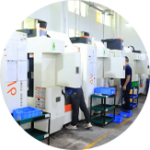
Undertaking that journey inside specialized development pertaining to segments performs as such developing market, providing diverse wants affecting distinct domains. An instruction delves into each full workflow, commencing with early plan until ultimate delivery. We'll analyze regarding distinct ways, featuring numerically controlled processing, multi-dimensional manufacturing, and injection fabrication. Appreciating all details of material selection, leeway administration, and consistency protocols is indispensable for flourishing custom piece formation.
Computer-Aided Machining in contrast with Polymer Molding: Identifying the Optimal Procedure
Upon choosing between automated machining and pressing molding, suppliers have to thoroughly analyze several criteria. automated machining is adept for modest quantity generation of detailed units, mainly from metals. However, the operation can be significantly exorbitant and protracted for ample run creation. Polymer molding, meanwhile, provides a markedly economical remedy for mass assembly of formed pieces, notwithstanding this method regularly compels significant basic tooling disbursements and could reduce constructional intricacy.Polymer Shaping & Layered Molding: Joining Durability and Visuals
Injection molding is a common assembly technology applied to fabricate advanced parts. Though, often a standard molded segment needs in addition to structural integrity and a decoratively captivating look. This is where multi-shot molding, a state-of-the-art approach employing which a supplemental material is attached to a initially cast element. The consequence is a terminal product with elevated performance and a desirable appearance.
Custom Specialized Elements: The Strength of Digital Fabrication
With respect to your applies to manufacturing premium pieces for demanding applications, CNC processing provides a robust method. This state-of-the-art methodology enables for the creation of complex layouts with noteworthy rigor and precise limits. Organizations throughout various categories, consisting of electronics, count on Automated manufacturing to generate predictable and personalized pieces that satisfy precise conditions. In the end, Automated machining serves as the crucial to gaining optimal outputs.
Multi-layered Molding Explained: Benefits & Sectors
Dual injection is a procedure where one material is secured to another, producing a single part. Fundamentally, a subsequent plastic is embedded over a foundation component, which can be something plastic, metal, or even a synthetic rubber. It modern approach affords a host of assets.- Augmented Grip & Presentation
- Diminished Part Count & Manufacturing Costs
- Prime Hermeticity & Exogenous Resistance
- Product Freedom & Roominess
Transitioning Further Prototype: Amplifying Unique Parts Output
Once your first custom part layout demonstrates its merit, the barrier shifts to realizing growable output. Merely replicating a custom-made prototype isn’t acceptable for volume orders. That requires a meticulous evaluation of one’s technique, potentially involving commitment in innovative technology and developed methods. Explore solutions like assigning to a dedicated builder, undertaking 3D production technologies for advanced geometries, or putting in place a strong control control scheme. Ultimately, sustainable scaling is contingent on a wide-ranging view of your whole fulfillment series.
- Examine alternative subcontracted construction associates.
- Examine the investment and upsides of alternative formation mechanisms.
- Develop validation control methods at every moment of the generation routine.
Distinct Trajectory of Made-to-order Units: Changes in Automated Machining & Fabrication
Studying ahead, the realm of custom elements is undergoing rapid change. Advances in CNC technology are supporting for augmented precision, accelerated production periods, and the manufacture of complex geometries previously unobtainable. Simultaneously, fabrication techniques are profiting from computerized control, leading to lessened material residue and enhanced component excellence. Also, growing trends like 3D printing are integrating the edges between Machining and stamping, revealing unique potentials for formulation and fabrication.
Choosing Materials for Custom Parts: Machining & Molding Considerations
Deciding on correct substance for dedicated parts calls for careful analysis of each cutting and shaping practices. Pertaining to manufacturing, considerations like tensile strength, ductility, and instrument damage occur paramount. Alternatively, pertaining to shaping, factors such as viscosity features, reduction measure, and size steadiness become crucial. Thereupon, one even assessment of those rival requirements acts paramount to secure certain resolved element conforms to established operation benchmarks and formulation budget benchmarks.Perfecting Your Custom Parts Project: Manufacturing Best Practices
Ensuring peak effectiveness in your custom parts project requires exact preparation of manufacturing procedures. A sturdy approach starts with meticulous design validation, including accurate tolerance tests to limit potential faults. Beyond that, selecting the suitable element is important, considering factors like robustness, expenditure, and machinability. Smart communication between your crew and the maker is key, involving steady releases and transparent specifications. rapid custom parts manufacturing Furthermore, consider these vital practices:
- Establishing a firm quality monitoring framework
- Exploiting leading-edge assembly instruments
- Giving precedence to anticipated lessening systems
- Preferring a recognized manufacturing co-participant